 Subscribe to one of our feeds:
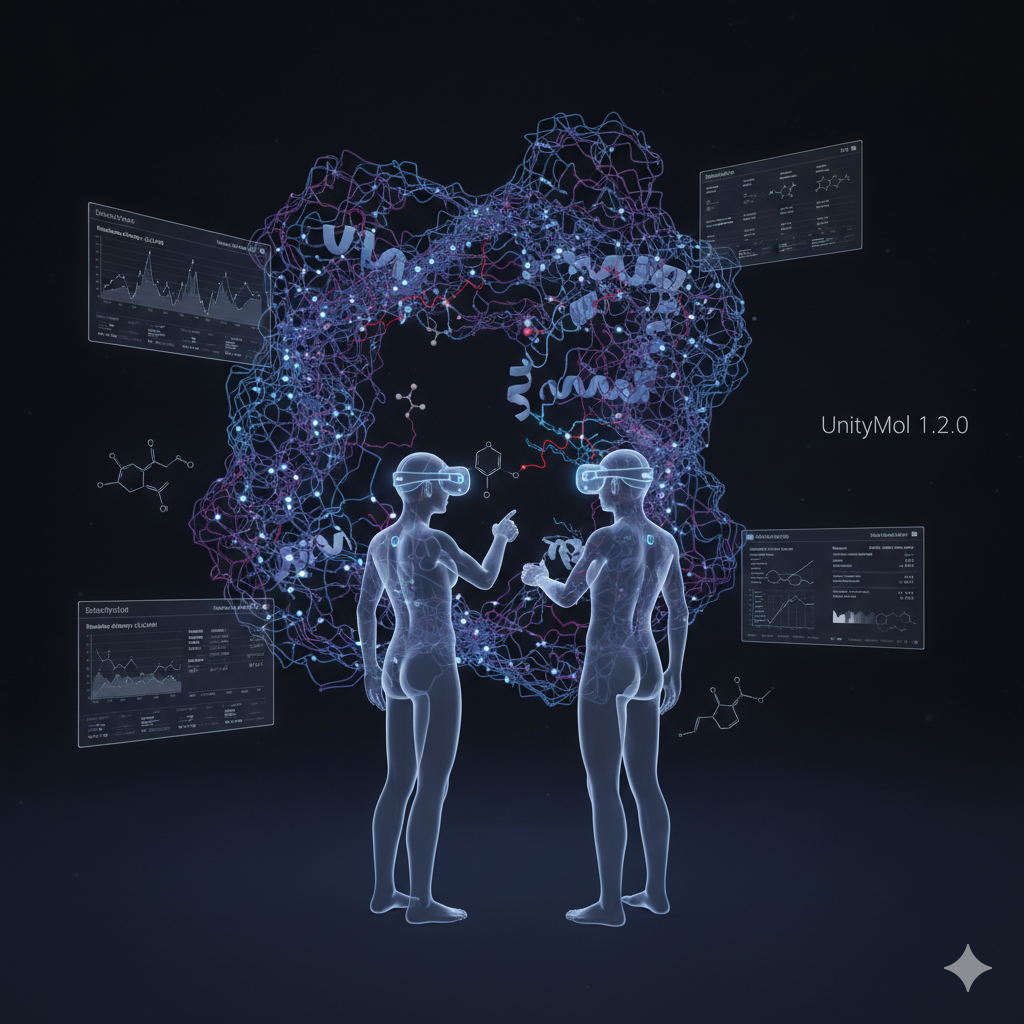
Over the past months, we’ve been pushing hard on one question:
- how can we make molecular visualization and interaction feel as natural and powerful as the science behind it?
This new release is a major step in that direction.
Here’s what changes in practice for your everyday research:
- VR that behaves like a first‑class citizen. UnityMol 1.2.0 ships with better VR support based on the VIU framework. In plain terms: setup is cleaner, hardware support is broader, and the experience is less demo, more tool you can actually use with students, collaborators and reviewers.
- True multiplayer molecular exploration. We’ve added a new multiplayer mode using Photon. That means you can quite literally stand inside the same system with your collaborators – discuss a binding site, a pore network, or a conformational change while pointing at it in 3D, in real time, instead of sending yet another static screenshot on Slack.
- Performance where it matters. A threaded XTC reader now keeps large trajectories flowing more smoothly. For those of you navigating multi‑microsecond MD, this is about staying in the “insight zone” instead of waiting for frames to catch up.
- Extended Python API. We’ve expanded the API available from the Python console. This makes it easier to script repeatable visualization workflows, integrate UnityMol into your existing MD analysis pipelines and build custom teaching or communication experiences around your data.
- Mac Silicon support. For the many scientists now on Apple Silicon laptops: yes, there is a dedicated build. No more workarounds just to show your own molecules on your main machine. All binaries (Linux, Windows, macOS – including VR on Windows) are available on the release page, along with the full changelog for those who enjoy reading diffs as much as papers.
If your work touches molecular modelling, structural biology, soft matter, or if you teach and communicate science, I believe tools like UnityMol should feel less like “extra work” and more like natural extensions of how you think about systems in 3D.
We’re not there yet, but 1.2.0 nudges us closer.
👉 Curious to hear from you:
What would make collaborative, VR‑enabled molecular visualization a default part of your research or teaching workflow rather than a nice side experiment?
You can access the full ChangeLog here.