This is UnityMol's official news blog, with the latest information and software developments, new features, applications and related topics.
On this landing page you can see a history of news and updates. For further articles, please use the search bar or navigate through the colored tags. Just below is also a simple tag cloud.
Over the past months, we’ve been pushing hard on one question:
how can we make molecular visualization and interaction feel as
natural and powerful as the science behind it?
This new release is a major step in that direction.
Here’s what changes in practice for your everyday research:
VR that behaves like a first‑class citizen.
UnityMol 1.2.0 ships with better VR support based on the VIU framework.
In plain terms: setup is cleaner, hardware support is broader, and the
experience is less demo, more tool you can actually use
with students, collaborators and reviewers.
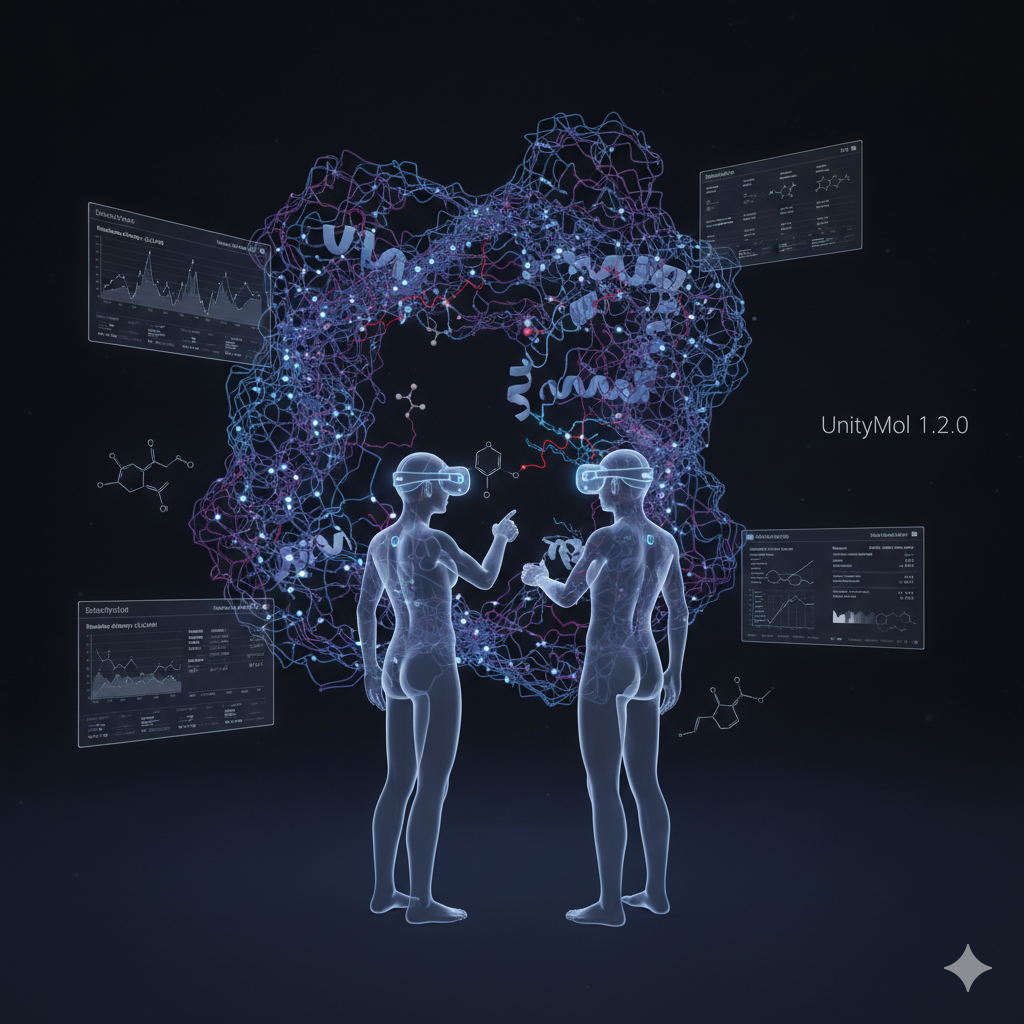
True multiplayer molecular exploration. We’ve added
a new multiplayer mode using Photon. That means you can quite literally
stand inside the same system with your collaborators – discuss
a binding site, a pore network, or a conformational change while
pointing at it in 3D, in real time, instead of sending yet another
static screenshot on Slack.
Performance where it matters. A threaded XTC reader
now keeps large trajectories flowing more smoothly. For those of you
navigating multi‑microsecond MD, this is about staying in the “insight
zone” instead of waiting for frames to catch up.
Extended Python API. We’ve expanded the API
available from the Python console. This makes it easier to script
repeatable visualization workflows, integrate UnityMol into your
existing MD analysis pipelines and build custom teaching or
communication experiences around your data.
Mac Silicon support. For the many scientists now on
Apple Silicon laptops: yes, there is a dedicated build. No more
workarounds just to show your own molecules on your main machine. All
binaries (Linux, Windows, macOS – including VR on Windows) are available
on the release page, along with the full changelog for those who enjoy
reading diffs as much as papers.
If your work touches molecular modelling, structural biology, soft matter, or if you teach and communicate science, I believe tools like UnityMol should feel less like “extra work” and more like natural extensions of how you think about systems in 3D.
We’re not there yet, but 1.2.0 nudges us closer.
👉 Curious to hear from you:
What would make collaborative, VR‑enabled molecular visualization a default part of your research or teaching workflow rather than a nice side experiment?
We are pleased to announce the addition of DeepWiki to the UnityMol website - an AI-generated, comprehensive code and project overview that provides in-depth documentation for UnityMol. This intelligent documentation system provides detailed insights into the codebase structure, implementation details and project architecture, making it easier for developers and researchers to understand and support UnityMol. You can access DeepWiki via the link in the footer of our website to explore the technical foundations of the framework in depth.
Quite excited to share our latest review article, "Virtual reality in drug design: Benefits, applications and industrial perspectives," published in Current Opinion in Structural Biology. This article delves into how virtual reality (VR) is transforming structure-based drug design by enabling immersive visualization and real-time manipulation of complex molecular structures. We discuss various applications of VR in drug discovery, including its role in COVID-19 research and protein-ligand docking, and present insights from pharmaceutical industry experts on integrating VR into existing workflows. The full article is freely available.
We are thrilled to announce the launch of the new UnityMol documentation website! This site offers comprehensive resources, tutorials, and guides to help you navigate and utilize UnityMol's features effectively.
Whether you're a seasoned user or just starting out, our documentation is designed to support your journey in molecular visualization and prototyping. Explore the new site and enhance your UnityMol experience today!
We are pleased to announce the publication of our latest paper: Escape from PharmaZ: a Game to Boost Pharmacophore Learning through Immersive Augmented Reality. This paper addresses a fundamental challenge in pharmaceutical education - how to teach the complex concept of pharmacophore in an engaging and effective way. UnityMol is used for this purpose. Pharmacophores represent the essential 3D features that drug molecules need to interact with their biological targets and are therefore critical to understanding how drugs work. However, students often struggle with this concept because it is abstract and complex three-dimensional molecular arrangements are difficult to visualize. Our solution? Escape from PharmaZ - an innovative hybrid serious game that combines a cooperative board game with a special augmented reality smartphone app. Students can physically manipulate the game pieces while using AR technology to visualize and interact with 3D molecular structures in real time. The results of our pilot study with 24 volunteers are promising and show a significant improvement in pharmacophore understanding, especially among chemistry novices. The combination of tactile gameplay and immersive AR visualization helps students understand both the spatial relationships and combinatorial nature of pharmacophore features.
Watch the accompanying video to see the game in action!
The paper "Democratizing Interactive Molecular Simulations and Analyses with a Portable, Turnkey Platform" describing MolPlay just got published in the /Journal of Physical Chemistry B/. I hope it will provide complementary information about the vision behind MolPlay and may be also of much interest to UnityMol users.
Marc Baaden /MolPlay: Democratizing Interactive Molecular Simulations and Analyses with a Portable, Turnkey Platform/ The Journal of Physical Chemistry B 2024 128 (38), 9132-9142 DOI: 10.1021/acs.jpcb.4c04712
Computer-based tools for visualizing and manipulating molecular structures in real-time hold immense potential for accelerating research and improving education, but are only used to a limited extent. This paper explores the possibilities of these powerful techniques and presents a classification of common interactive modeling tasks, such as assembly, deformation, sampling of rare events, along with relevant use cases, especially for the study of membranes and membrane proteins. I introduce MolPlay─a platform that provides a ready-to-use software environment with a curated set of hands-on examples to democratize access to interactive molecular simulations and analyses (IMSA). These research tools allow researchers to visualize, manipulate, and study digital models of molecules in real-time and can be started directly from a small, portable storage device. The portable, self-contained nature of MolPlay enables versatile deployment scenarios ranging from outreach to teaching in computer laboratories to facilitating the distribution of research software. Initial tests at an international workshop have shown that MolPlay appeals to different target groups and lowers the access barriers to IMSA. By consolidating more than a decade of expertise into one accessible platform, MolPlay represents a significant step toward broader adoption of these underutilized but powerful computational techniques in education and research.
After quite a few days of experimenting and video recording, the MolPlay Essentials youtube video walkthrough series is now avaiable online. It has it's dedicated playlist to make it easy to access the videos. All molecular visualizations were done using UnityMol!
Today the first ISO image of MolPlay is released. MolPlay features UnityMol for interactive molecular simulation and analysis examples. Now everyone can download, install and test the MolPlay virtual molecular playground!
The molplay_v1.0.img.gz image is available for download here. The md5sum checksum is 992287f3d2bceed9ff8e87b3e6d09f42.
The brand new MolPlay website has gone online. It features UnityMol very prominently in many application examples.
MolPlay is an innovative platform designed to make interactive molecular simulations and analyses (IMSA) accessible to a wide range of users. It combines powerful computational techniques with an intuitive interface, allowing researchers, educators, and students to explore complex molecular systems in real-time.
The UnityMol team is excited to bring MolPlay to you and hope you will have fun with the software and also do some exciting research and interactive simulations with it. Feedback is always welcome.
This was a long over-due update of the whole website. The first stage is mostly having re-designed the original website contents with a new toolchain based on Emacs org-mode and lazyblorg as described in the credits in detail.
We received a SourceForge community choice award in 2022! Below the badge is an excerpt from the official message received.
Hi Marc Baaden,
Congratulations! UnityMol has just been recognized with a Community Choice award by SourceForge. This honor is awarded only to select projects that have reached significant milestones in terms of downloads and user engagement from the SourceForge community.
This is a big achievement, as your project has qualified for this award out of over 500,000 open source projects on SourceForge. SourceForge sees nearly 30 million users per month looking for, and developing, open source software. [..]
Congrats again on winning and keep doing amazing work because SourceForge and our users appreciate it!
UnityMol 1.0.36 is now available. We’ve been listening to your feedback, and providing bug fixes and updates accordingly! Check out all of the new features below! We just released the new source code on github. Version 1.0.36 of the open source edition of UnityMol has the following changelog and main features that were improved:
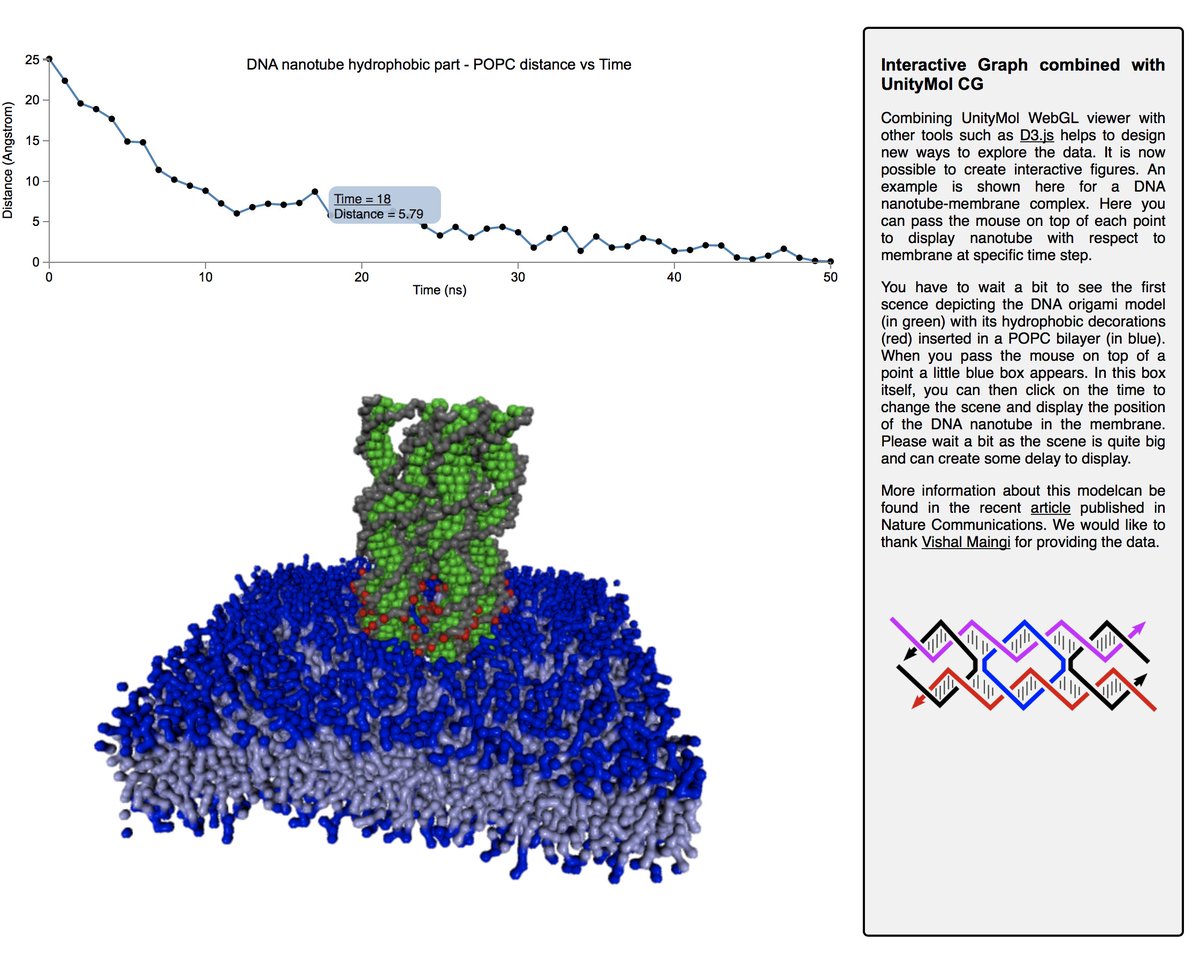
An interactive graph showing DNA nanotube insertion in a POPC membrane using WebGL and UnityMol CG based on a model from @maingivishal. Try the web-based UnityMol app.
Combining UnityMol WebGL viewer with other tools such as D3.js helps to design new ways to explore the data. It is now possible to create interactive figures. An example is shown here for a DNA nanotube-membrane complex.
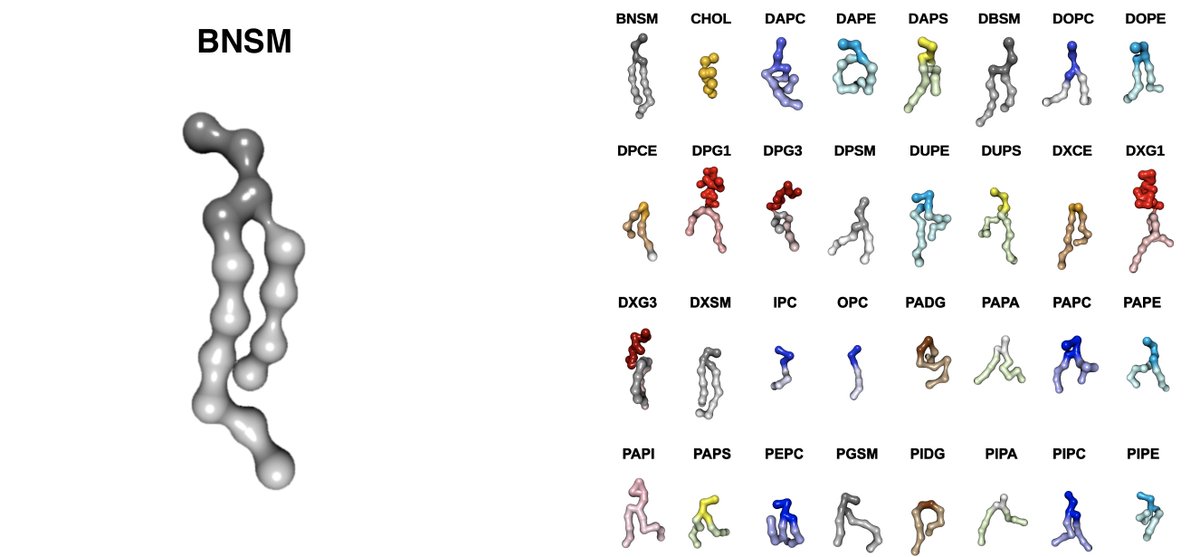
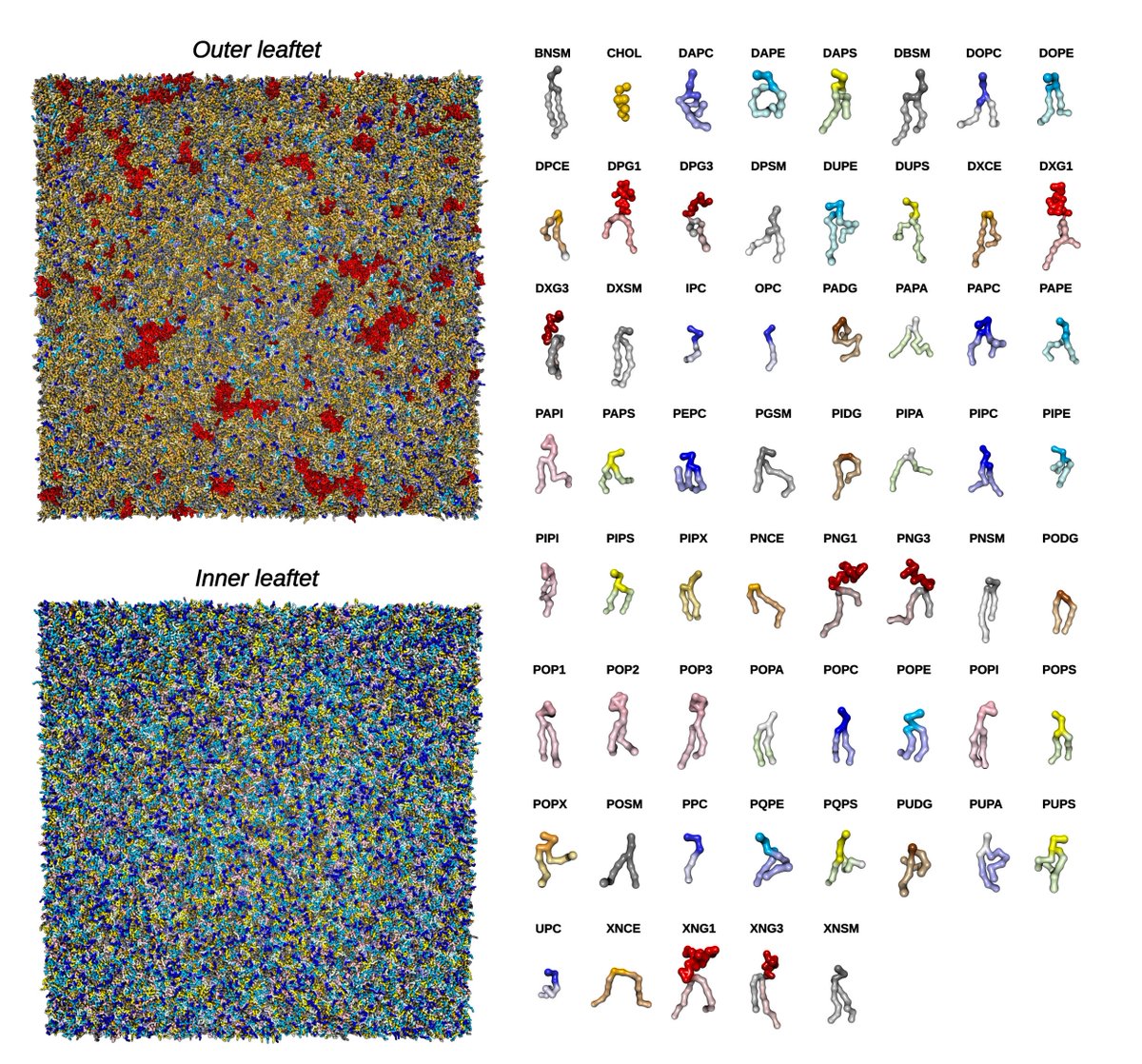
Interactive rendering of CG lipid models using UnityMol. You can click on each lipid on this experimental web-app based on UnityMol.
The lipid structures were extracted from a complex membrane model developed by the Marrink lab at the University of Groningen. Here you can see the diversity of lipids in this membrane. The type of force field used is MARTINI: a coarse grain forcefield where one particle depicts 3-4 heavy atoms. Matthieu used unitymol to render these lipid models.
UnityMol screen recording illustrating ways to show protein as a ribbon and ligand as licorice, space-filling or other representation. The example was recorded with the latest 0.9.7-series VR build of UnityMol.
In this video you discover how to fine-tune ligand-protein complex representations using the latest UnityMol virtual reality build! This tutorial demonstrates key features, including switching on secondary structure views, selectively hiding and unhiding residues like heme, and enhancing visualization with advanced rendering options such as ring blending and sugar-related menus. Perfect for exploring intricate molecular structures with precision and customization.
 Subscribe to one of our feeds: